Vibe Code Camp
 GitHub
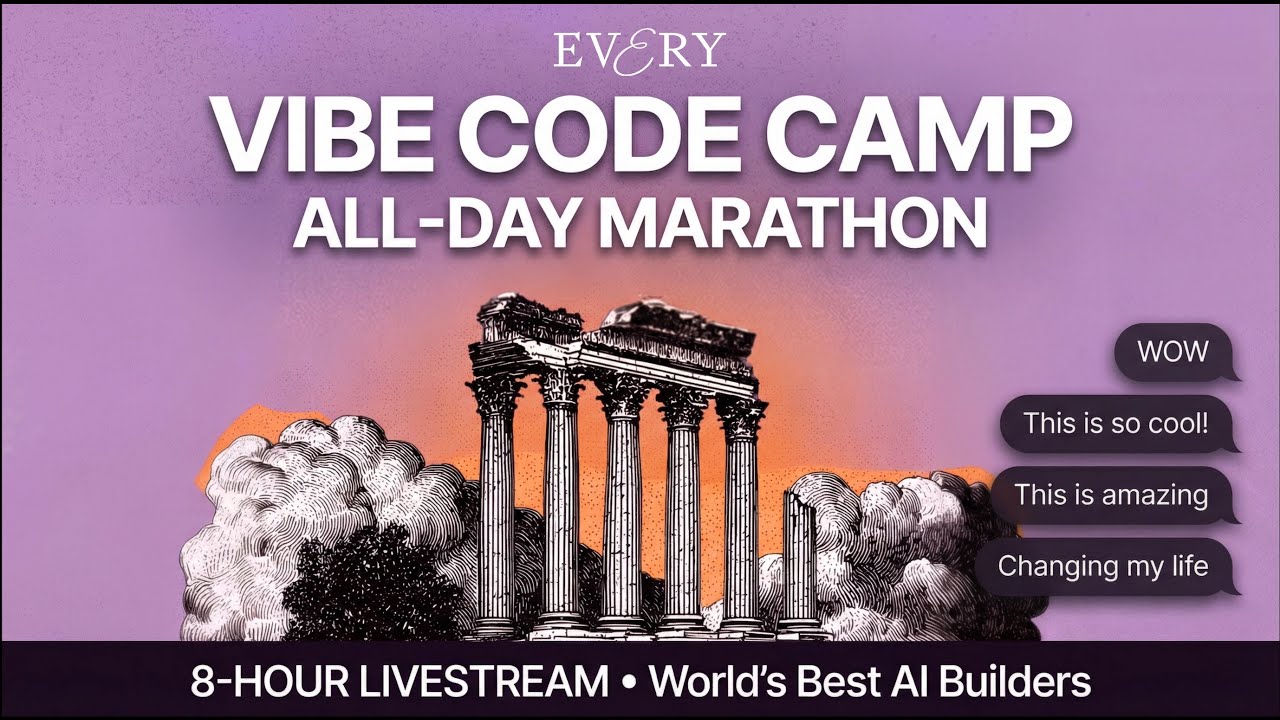
Click the thumbnail to watch on YouTube (opens in a new tab)
Overview
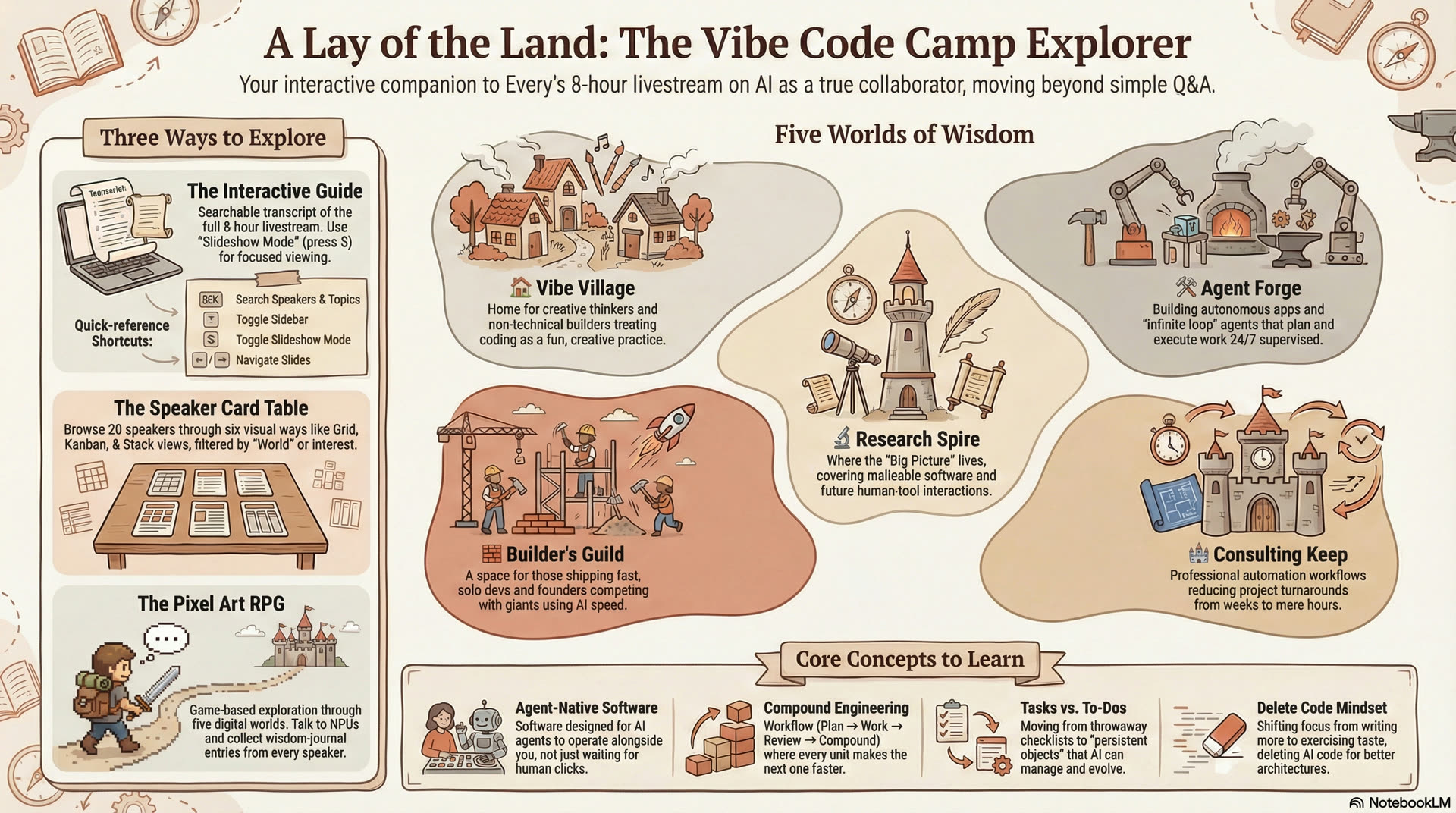
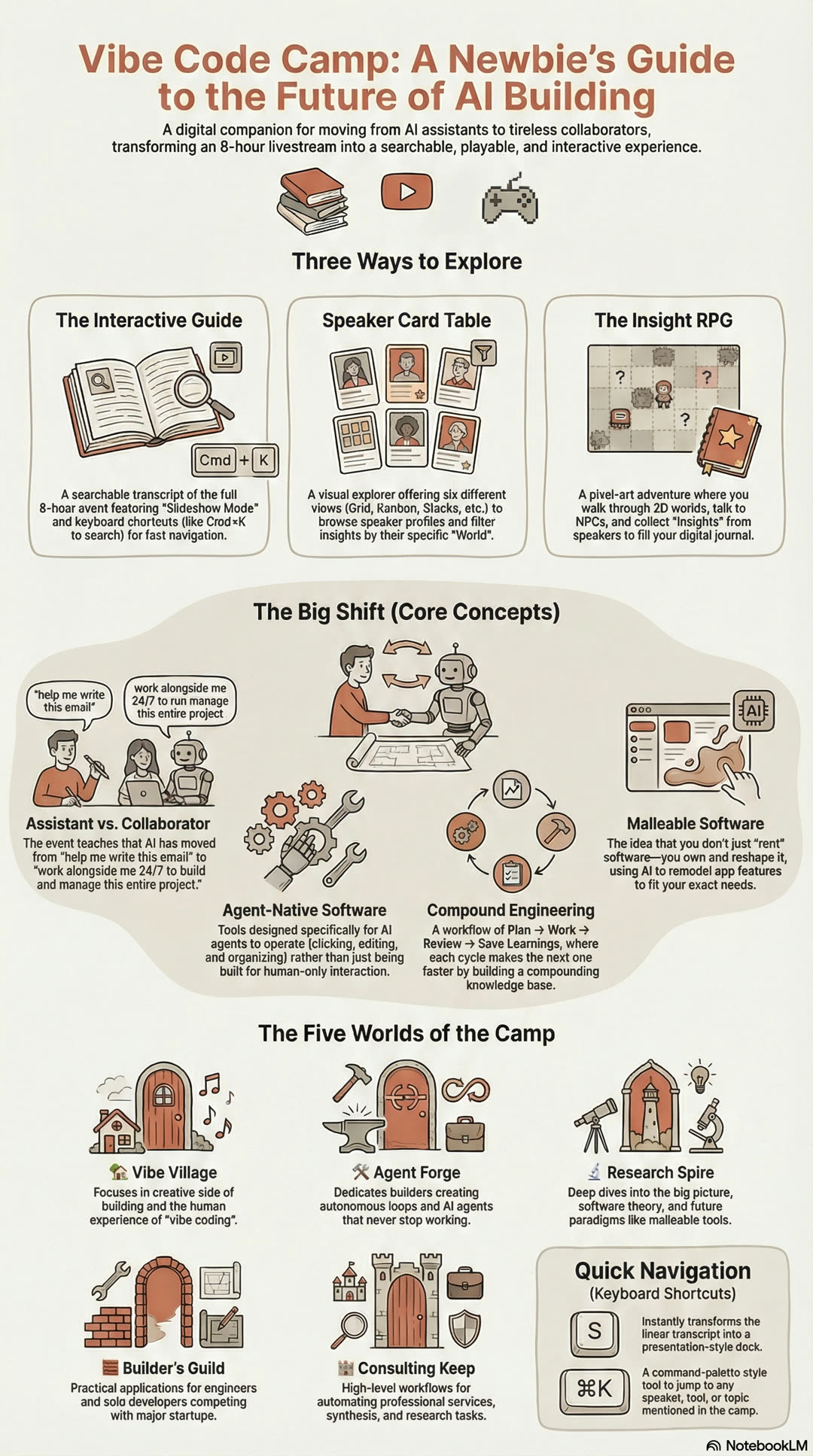
This transcript captures practical workflows, tool recommendations, and real demos from founders, engineers, and creators shipping production software with AI. Use it to learn from specific speakers, find relevant sections for what you're building, or surface actionable insights.
How to use this resource:
- Press S for slideshow mode — use arrow keys to navigate
- Use Cmd+K to search speakers, topics, and tools
- Click any speaker to jump to their section
- Timestamps link directly to that moment in the video
The Big Shift
Before you dive into the concepts and speakers, here's the core idea that runs through the entire event:
The speakers aren't just asking AI to answer questions. They're building systems where AI agents plan, execute, review, and improve—sometimes running 24/7 without human supervision.
This isn't science fiction. People are shipping real products, running real businesses, and building real tools using these approaches today.
Where Should You Start?
8 hours is a lot. Pick a path based on what you're interested in:
Core Concepts
These are the key ideas discussed throughout the event. Each one builds on the others—click the related links to see how they connect, or jump to speakers who explain them best.
Agent-Native Software
AgentsMost apps today were built for humans to click around. Agent-native software is designed differently: it's built so that an AI agent can operate the app alongside you—creating, editing, organizing, and automating tasks just like a skilled coworker would.
If you use any software regularly—even just Google Docs or Notion—this matters. Imagine your tools could actually do work instead of just waiting for you to click buttons. That's where software is heading.
Tasks Replace To-Dos
PhilosophyA to-do list is something you check off and throw away. A task is more like an object in your world—it persists, evolves, connects to other things, and can be picked up by you or an AI agent at any time.
If you've ever felt overwhelmed by your to-do list, this reframe helps. Tasks aren't about "getting to inbox zero"—they're about maintaining an honest map of your commitments. And when AI can see that map, it can actually help manage it.
Compound Engineering
WorkflowA workflow where you: Plan → Work → Review → Save learnings. The key insight is that the "save learnings" step makes your next cycle faster. Over time, your building velocity compounds—just like interest in a savings account.
Most people work in fits and starts, losing context between sessions. This approach means you never start from zero. Your AI collaborator remembers what worked, what failed, and what to try next.
Malleable Software
PhilosophyMost software is like renting an apartment: you can move furniture around, but you can't knock down walls. Malleable software is like owning your home—you can renovate, expand, and reshape it to fit your life.
Ever wished an app worked slightly differently? With malleable software, you don't wait for the vendor's roadmap—you (or an AI) just change it. This is the endgame of the "agent-native" movement.
MCP (Model Context Protocol)
ToolsMCP is a standard way for AI models to connect to external tools and knowledge. Instead of copy-pasting documentation into a chat window, the AI can query your docs, repos, or databases directly.
If you've ever spent 10 minutes explaining context to an AI, MCP fixes that. Your AI can look things up itself—reliably and repeatedly. It's the difference between hiring someone who needs constant hand-holding vs. someone who can find their own answers.
Multi-Model Teams
AgentsInstead of asking one AI to do everything, you set up a team: one model acts as the engineering manager (planning, reviewing, deciding) while another acts as the implementer (writing code, executing tasks).
This mirrors how real teams work—and it turns out AI teams work better this way too. The "manager" can catch mistakes, maintain context, and decide when something's actually done. The "implementer" can focus on execution.
Delete Code Mindset
PhilosophyAs AI gets better at writing code, the competitive advantage shifts. It's no longer "who can write more code"—it's "who knows what to build, and how to steer." You might actually delete more code as you go, re-architecting frequently.
If you're not a programmer, this is actually good news: the barrier to building software is dropping fast. If you are a programmer, the value shifts toward judgment, taste, and understanding what users actually need.
Learn by Taking Apart
WorkflowInstead of designing from scratch, study products you admire. Take them apart to understand their patterns—the flows, affordances, feedback loops. Then rebuild those patterns in your own work.
This is how you learn faster. Great products aren't magic—they're patterns that work. Once you can see the patterns, you can apply them anywhere. And AI is great at helping you analyze and reproduce patterns.
Speaker Profiles
Meet the 17 speakers from the event. Each profile includes timestamps, topics, and key insights.
Dan Shipper
Dan Shipper
Every CEOIntroduction & Proof/Anecdote - Agent-native markdown editor demo
- Introduces Every's three pillars: Ideas, Apps, and Training
- Demos Proof - an agent-native markdown editor built for humans and agents
- Shows track changes, human vs AI attribution, and Every's style guide review
- "This is a project that should have taken a group of engineers six months... I just vibe coded it in my spare time and have absolutely no idea how any of the code works."
- Explains what agent-native apps are and points to Every's guide
Ben Tossell
Ben Tossell
Ben's Bites / FactoryNon-technical builder sharing agent sessions
- "I can't code, still can't. I've tried and just couldn't get it to work for me."
- Built and sold MakerPad (no-code education) to Zapier
- Demos a session reviewer tool that exports terminal sessions to a visual UI
- Shows one-shot building — "10 minutes ago I built this popup for today's demo"
- Strategy: Find other agents' code, adapt it for your needs
Ashe Magalhaes
Ashe Magalhaes
Hearth AIBuilding a personal AI suite for relationship context
- Former founder of Hearth AI, focused on relational intelligence
- Builds a personal Rolodex/journal with notes about people and relationships
- Prefers high-signal personal context over noisy integrations
- Builds for personal use first, then considers sharing it on GitHub
Ryan Carson
Ryan Carson
Founder, UntangleAMP infinite loop agent that never stops working
- Former builder in residence at AMP
- Introduces "Compound Product" - autonomous product improvement loops
- "We all feel stressed because we can't loop our agents 24/7"
- Open source repo for infinite loop agent patterns
- Works across AMP, Claude Code, Cursor, or other agentic tools
Natalia Quintero & Nityesh Agarwal
Natalia Quintero & Nityesh Agarwal
Every ConsultingAI consulting workflows for deck creation and synthesis
- Demos a deck Claude generated from rough inputs
- Uses AI to outline slides and draft copy for v1 decks
- Reduces deck turnaround from days/weeks to a few hours
- Frees time to focus on client needs and design refinement
Katie Parrott
Katie Parrott
Every EditorialClaude Code for editorial workflows and writing ops
- Staff writer and AI editorial lead at Every
- Demos Claude Code in the cloud app plus the Compound Engineering plugin
- Revisits an editorial ops project and runs codebase reviews/audits
- Goal: one app to manage editorial feedback and production workflows
Nat Eliason
Nat Eliason
AuthorClaudeBot: The Mac Mini agent running 24/7 unsupervised
- Started vibe coding with Cursor in early 2024
- "The one thing Claude can't do is give me a haircut"
- Runs Claude Code on dedicated Mac Mini 24/7
- Journey from skeptic to full believer in agentic coding
- Systems for managing always-on AI agents
Tina He
Tina He
Pace CapitalVibe coding as creative practice — "infinite maze" demo
- Tinkerer, writer, and investor at Pace Capital; previously built dev tools at Coinbase/Base
- Emphasizes fun and creativity as the core of vibe coding
- Demos an "infinite maze" app that rewrites frustrated messages into corporate language
- Builds with Claude Code + Codex and uses prompts/skills to shape the UI
Paula Dozsa
Paula Dozsa
PortolaProduction iOS features for Tolan with Claude
- iOS engineer at Portola building Tolan, an AI companion app with hundreds of thousands of users
- Uses Claude and Opus to ship production features (not just prototypes)
- Claude handles UI work while she focuses on iOS/Unity integration
- Shares team workflows: Slack/Linear integrations, Opus/Sonnet review roles, and pre/post hooks
CJ Hess
CJ Hess
TenexFlowy: diagram-first planning with JSON for Claude
- Built Flowy, a local Figma-like tool that saves flows and mockups as JSON
- References those JSON diagrams in plans so Claude can iterate on UI and flows
- Demos adding a quiz feature using the Flowy skill and updated diagrams
- Prefers skills/CLIs to reduce context bloat; MCPs are helpful but imperfect for design transfer
Logan Kilpatrick & Ammaar Reshi
Logan Kilpatrick & Ammaar Reshi
GoogleThe latest from Google AI Studios
- Latest developments in Google AI Studio
- Gemini capabilities and roadmap
- Google's perspective on the AI development landscape
- Integration opportunities with Google's AI tools
Geoffrey Litt
Geoffrey Litt
NotionMalleable software - Apps that rewrite themselves
- Malleable software paradigm - users can modify their tools
- Apps that adapt and rewrite themselves
- Research perspective on end-user programming
- How Notion thinks about AI-powered customization
Kevin Rose & Kieran Klaassen
Kevin Rose & Kieran Klaassen
True Ventures / EveryCompound Engineering: Plan, work, review, compound
- Compound Engineering methodology: Plan → Work → Review → Compound → Repeat
- "Each unit of engineering work should make subsequent units easier"
- Kevin Rose using the Compound Engineering plugin
- How to build knowledge that compounds over time
- The plugin that started from Every's internal tooling
Thariq Shihipar
Thariq Shihipar
AnthropicInside Anthropic: Why tasks will replace to-dos
- Inside perspective from Anthropic
- The future of tasks vs to-dos in AI-native workflows
- How Anthropic thinks about Claude Code's evolution
- The shift from human execution to AI execution
Naveen Naidu
Naveen Naidu
Every / MonologueOne developer vs VC-backed voice note giants
- Building Monologue — Every's smart voice-to-text Mac app
- Solo developer competing with VC-backed startups
- iOS development workflow with AI assistance
- Speed and iteration advantages of AI-assisted development
Yash Poojary
Yash Poojary
Every / SparkleReverse engineering ChatGPT and Spotify to learn faster
- Reverse engineering popular apps to understand patterns
- Learning by deconstructing ChatGPT and Spotify
- Building Sparkle - Every's file organizer
- Accelerated learning through AI-assisted analysis
Brooker Belcourt
Brooker Belcourt
Every ConsultingHedge fund research workflows in ~20 minutes with Claude
- Background in hedge funds and fintech; uses Claude as a research assistant
- Uses slash commands/plugins to build earnings previews and dashboards
- Claude accesses files/MCPs and runs code to compile sources
- Work that took ~5 hours can run in ~20 minutes of compute
Resources
Watch & Learn
- Full Video on YouTube (8 hours)
- Every Subscription - Ideas, apps, and training
Tools Mentioned
- Claude Code - Anthropic's agentic coding CLI
- Cursor - AI-first code editor
- AMP - Agentic development platform by Sourcegraph
- MCP - Model Context Protocol for tool access
- Context7 - MCP server for framework documentation
- Flowy - Diagram-first planning tool with JSON mockups
- Compound Engineering Plugin - Every's workflow methodology
Every Apps
- Proof - Agent-native markdown editor
- Cora - AI email assistant
- Monologue - Smart dictation app
- Spiral - AI ghostwriter with taste
- Sparkle - AI file organizer
Further Reading
- The Illustrated Guide to Building Agent-Native Apps
- What Is Compound Engineering?
- Geoffrey Litt on Malleable Software
- Vibe Code Camp GitHub Repo
Built something with this transcript? Tag @Every on X.
Search for speakers, topics, or tools